
A business analyst CV is your gateway to securing interviews in one of the UK's most competitive fields. With employers receiving hundreds of applications for each advertised role, your CV needs to pass applicant tracking systems (ATS) and immediately demonstrate your value to hiring managers.
In this article, we'll show you how to write a business analyst CV that showcases your analytical capabilities and measurable impact. Here, you'll find real-world examples, step-by-step writing guidance, and some mistakes you should avoid at all costs.
Key Takeaways
A strong business analyst CV combines technical skills, quantifiable achievements, and clear problem-solving abilities.
Junior BA CVs focus on transferable skills and tools, whilst senior CVs emphasise strategic impact and stakeholder management.
The reverse-chronological format works best, making career progression easy to track.
Essential skills include SQL, Excel, Tableau/Power BI, BPMN, requirements gathering, communication, and stakeholder management.
Common mistakes include generic bullet points, missing analytical tools, poor formatting, and failing to optimise for ATS.
2 Business Analyst CV Examples That Work
Here, we have two business analyst CV examples that demonstrate what works at different career stages:
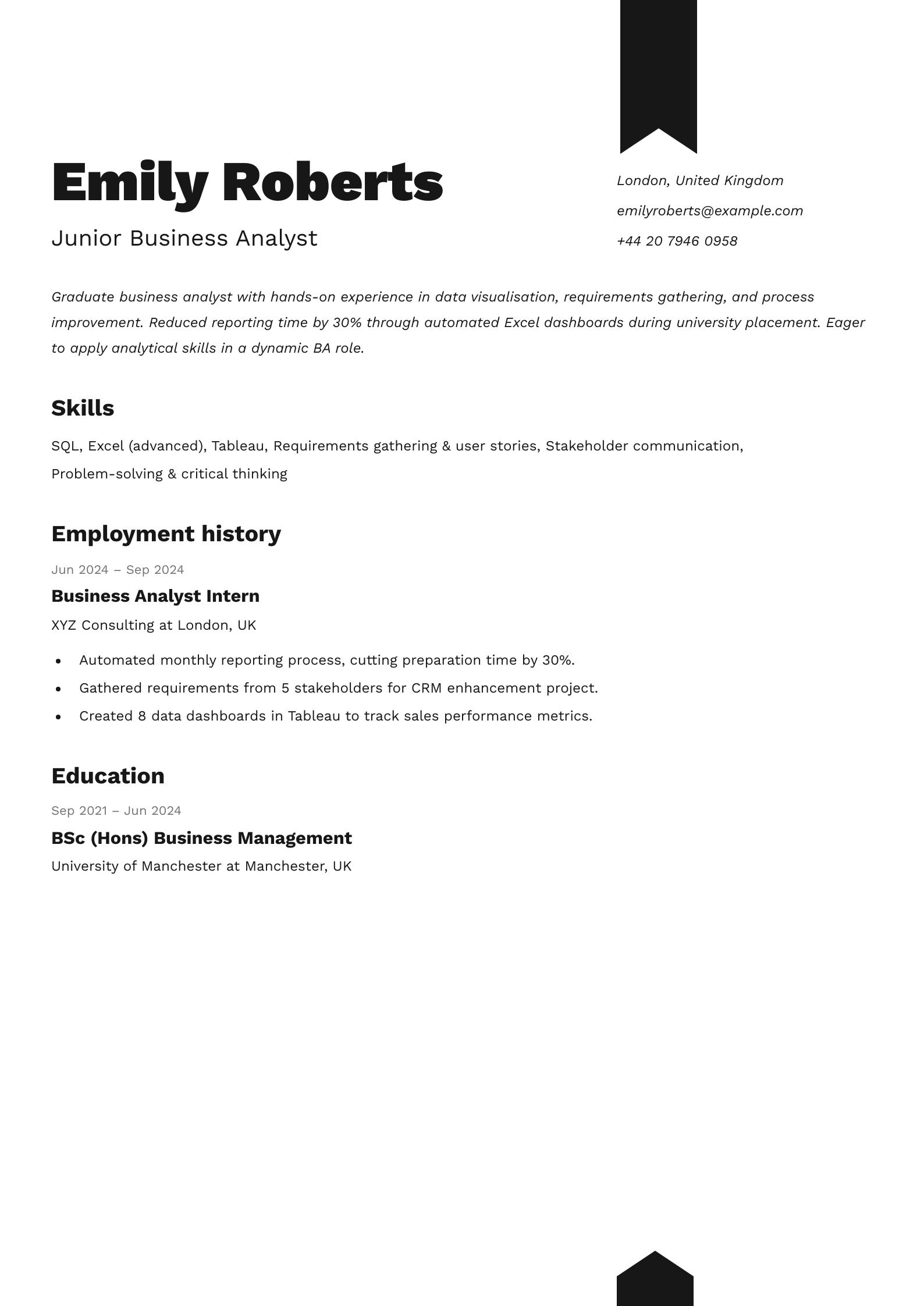
The example above focuses on transferable skills, quantifiable achievements, and relevant tools. The measurable outcome (30% reduction) demonstrates value, whilst the skills section shows technical competence.
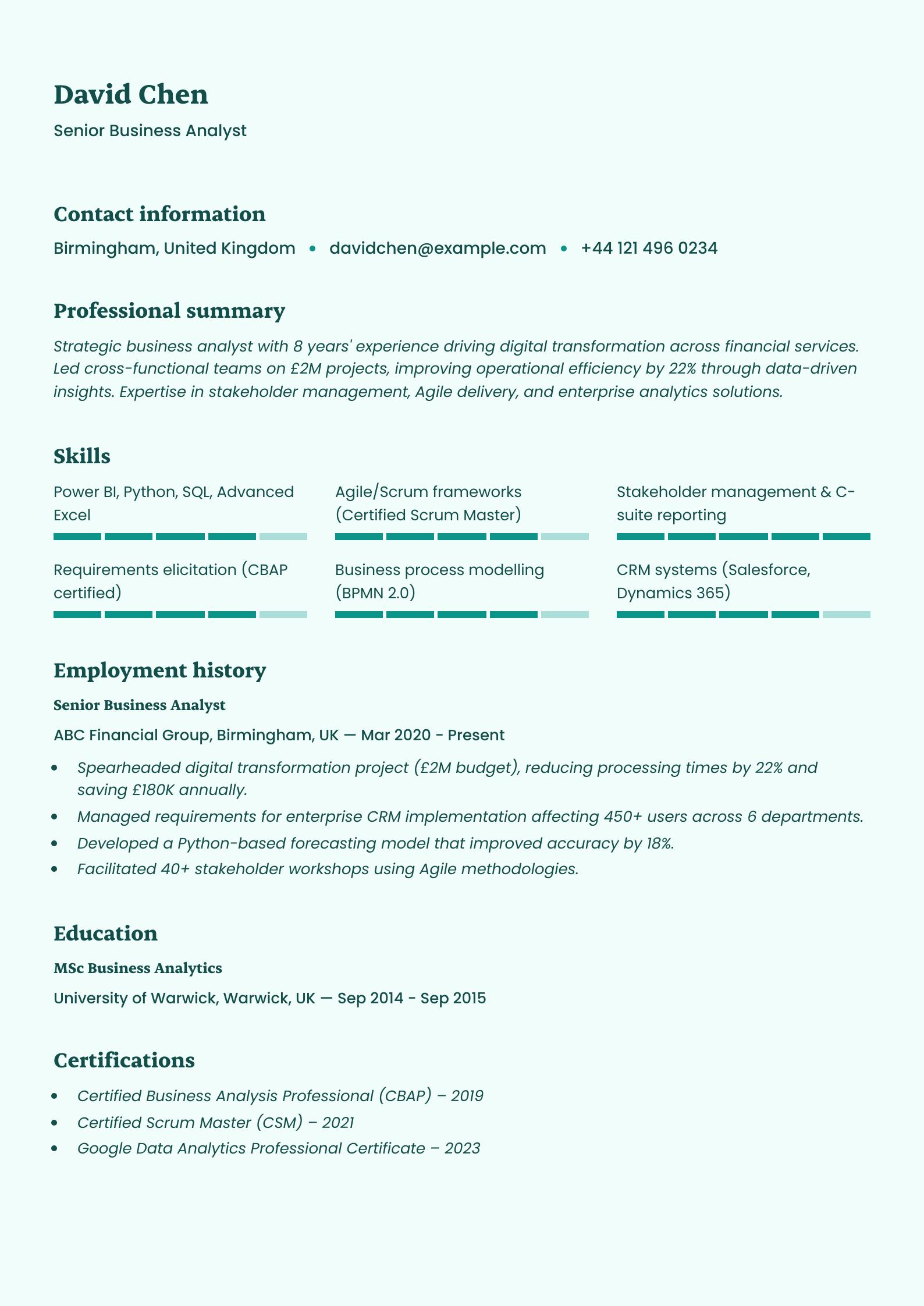
This sample demonstrates strategic thinking, large-scale project management, and measurable business impact. The combination of certifications, advanced tools, and executive stakeholder management positions the candidate as a senior contributor.
How to Write a Business Analyst CV in 5 Simple Steps
To write a proper business analyst CV, you should follow these five steps:
#1. Start With Your Contact Details and a Strong Headline
Your contact information should be clean and professional; include your full name, location (city and country), professional email address, phone number, and LinkedIn profile. If you've built data dashboards or case studies, add a portfolio link here as well.
Create a professional headline that positions your specialisation. Rather than simply stating "Business Analyst," be specific. Your headline should reflect the type of BA role you're pursuing, be it in data analytics, process improvement, systems analysis, or strategic planning.
Let’s see some good examples:
Headline Examples
Business Analyst specialising in Financial Modelling & Process Optimisation
Data-Driven Business Analyst | Agile Delivery Expert
Senior Business Analyst – Digital Transformation & CRM Solutions
#2. Highlight Key Business Analyst Skills
The skills section proves you have the technical abilities and soft skills needed to excel as a business analyst. Combine hard skills and soft skills in a scannable format that ATS systems can parse easily.
Let’s see which hard business analyst skills can include:
Hard Skills
SQL, Excel (advanced functions, pivot tables, macros)
Data visualisation tools (Tableau, Power BI)
Business process modelling (BPMN, UML)
Requirements gathering and documentation
User story creation and acceptance criteria
CRM/ERP systems (Salesforce, SAP, Dynamics)
Project management tools (Jira, Confluence)
Now, here are some critical soft skills you should include:
Soft Skills
Problem-solving and critical thinking
Stakeholder management and communication
Analytical thinking and attention to detail
Collaboration and teamwork
A good skills section demonstrates specific, job-relevant capabilities with recognisable tools, and here's how this looks in practice:
Good Example
Skills
SQL, Python, Advanced Excel (VBA, Power Query)
Tableau, Power BI (dashboard creation & reporting)
Requirements elicitation & user story mapping
BPMN 2.0, process modelling, gap analysis
Agile/Scrum methodologies
Stakeholder engagement & workshop facilitation
Problem-solving & data-driven decision making
#3. Showcase Work Experience With Measurable Impact
This is the most important section of your business analyst CV. Recruiters want evidence that you've delivered tangible value, not just a list of tasks. Therefore, you should use action verbs and quantify your achievements wherever possible.
Structure each bullet point like this:
Action verb + what you did + quantifiable result
That said, let’s see what this formula looks like in practice:
Good Example
Analysed customer data from 15,000+ transactions, identifying 3 key pain points that improved user satisfaction by 24%.
Developed an automated reporting dashboard in Power BI, reducing manual preparation time by 18 hours per week.
Facilitated 12 stakeholder workshops using Agile methodologies, aligning requirements for a £500K digital transformation project.
Optimised inventory forecasting model, cutting stockouts by 31% and saving £75K annually.
When possible, include percentages, time savings, cost reductions, or revenue increases. If you work in Agile environments, mention sprint management, backlog refinement, or Scrum ceremonies.
#4. Add Education and Certifications
Education remains important for business analyst roles, particularly for entry-level positions. List your degrees in reverse chronological order, including the qualification name, institution, location, and dates attended. If you graduated with honours or achieved a high grade (First Class or 2:1), include it.
Here’s what a good example looks like:
Good Example
Education
MSc Business Analytics September 2021–September 2022 University of Warwick, Warwick, UK
BSc (Hons) Economics – First Class September 2018–June 2021 University of Manchester, Manchester, UK
If you possess certifications, these significantly strengthen a business analyst CV. Consider the following:
Certifications
CBAP (Certified Business Analysis Professional) – demonstrates advanced BA expertise
ECBA (Entry Certificate in Business Analysis) – ideal for those starting out
Google Data Analytics Professional Certificate – showcases data analysis capabilities
AgilePM Foundation – proves understanding of Agile project delivery
Certified Scrum Master (CSM) – valuable for Agile-focused BA roles
If you're early in your career, you can also list relevant coursework such as statistics, database management, or business process modelling.
#5. Add Portfolio Links, Tools, and Extra Sections
Business analysts who showcase their work through portfolios stand out. Platforms like Tableau Public, GitHub, or personal websites work well, and here’s what you can include:
Portfolio Sections
Data dashboards demonstrating analytical skills
Case studies showing problem identification and solution implementation
Process maps or BPMN diagrams you've created
Requirements documents (with confidential information removed)
GitHub repository with Python, R, or SQL scripts
Beyond portfolios, consider adding languages as they’re valuable if you work in multinational companies. List each language with your proficiency level (e.g., Spanish – Professional, French – Conversational).
Also, you can include industry awards, employee recognition programmes, or academic honours if you have obtained/completed any, as these demonstrate excellence. If you've written articles or white papers about business analysis or data trends, add them as well.
How to Write a Business Analyst CV With No Experience
To write a business analyst CV with no experience, you should reframe your existing skills and highlight relevant projects. These may include internships, volunteering, and university projects; these experiences demonstrate analytical thinking and technical competency.
Furthermore, you need to emphasise transferable skills like analysis, research, communication, and teamwork. If you've worked in customer service or retail, you've likely gathered requirements, solved problems, and managed stakeholder expectations, which are all core BA competencies.
Highlight tools you've learned, even outside formal employment. If you've completed online courses in SQL, Excel, Python, or Tableau, list them. Additionally, mention any business case competitions, hackathons, or data challenges you've participated in.
Finally, consider pursuing entry-level certifications such as the ECBA or the Google Data Analytics Professional Certificate. These credentials signal commitment and provide structured learning that compensates for limited work experience.
5 Mistakes You Must Avoid When Crafting a Business Analyst CV
Here are the most common mistakes you may make when writing a business analyst CV:
Using generic bullet points. Saying "improved processes" or "supported stakeholders" tells recruiters nothing. Every bullet point should include specific actions and measurable outcomes. Instead of "helped reduce costs," write "identified inefficiencies in procurement workflow, implementing changes that reduced vendor processing time by 40% and saved £35K annually."
Not listing analytical tools. If your CV doesn't mention SQL, Excel, Tableau, Power BI, or similar tools, recruiters will assume you lack these skills. Create a dedicated skills section listing every relevant tool; this is crucial for passing ATS screening.
Poor formatting. Overly creative fonts, dense paragraphs, and unnecessarily long CVs all hurt your chances. Stick to professional fonts like Calibri or Arial at 10-12pt. Keep your CV length to a maximum of 2 pages (1 page if entry-level). Also, use clear headings, bullet points, and white space.
Not optimising for ATS. Many companies use applicant tracking systems (ATS) to filter CVs. If yours lacks keywords from the job description—terms like "requirements gathering," "stakeholder management," "SQL," "Agile," or "data visualisation"—it may never reach a hiring manager. Read job postings carefully and mirror their language, including relevant methodologies and tools.
Overly long paragraphs. Dense blocks of text are difficult to scan and often ignored. Break content into bullet points, keep paragraphs short (2-4 sentences maximum), and prioritise achievements over responsibilities. Recruiters care about what you accomplished, not just what you were supposed to do.
Create Your Business Analyst CV in Minutes
Create a job-ready business analyst CV in minutes with our professional CV builder—ATS-friendly, modern, and easy to customise.
All you should do is enter the information in the designated fields and let our software do the magic. Within minutes, you’ll have a submission-ready document that can help you stand out and land a business analyst interview in no time!
Final Thoughts
Writing a standout business analyst CV requires strategic positioning of your technical skills, quantifiable achievements, and business impact. Focus on demonstrating how you've used data and analysis to solve real business problems; with the help of our tool, examples, and templates, you can customise your CV for the role and make the best of your job application!
Business Analyst CV FAQs
#1. What should a business analyst put on a CV?
A business analyst should put contact details, a professional summary, a skills section listing technical tools (SQL, Excel, Tableau) and methodologies (Agile, BPMN), quantifiable work achievements, relevant education, and certifications such as CBAP or ECBA on a CV. Additionally, portfolio links to dashboards or case studies strengthen applications.
#2. What skills make a business analyst CV stand out?
The skills that make a business analyst CV stand out combine technical proficiency (SQL, Python, Power BI, advanced Excel) with business acumen (requirements gathering, stakeholder management, process modelling). Demonstrating Agile/Scrum experience, strong communication abilities, and problem-solving skills—backed by quantifiable achievements—is a plus and differentiates strong candidates.
#3. Do employers prefer CVs with a portfolio?
Yes, employers prefer CVs with a portfolio, as portfolios provide tangible evidence of your analytical capabilities. Including links to data dashboards, process maps, or documented case studies demonstrates practical skills beyond what a traditional CV can convey, making your application significantly more compelling to hiring managers.