
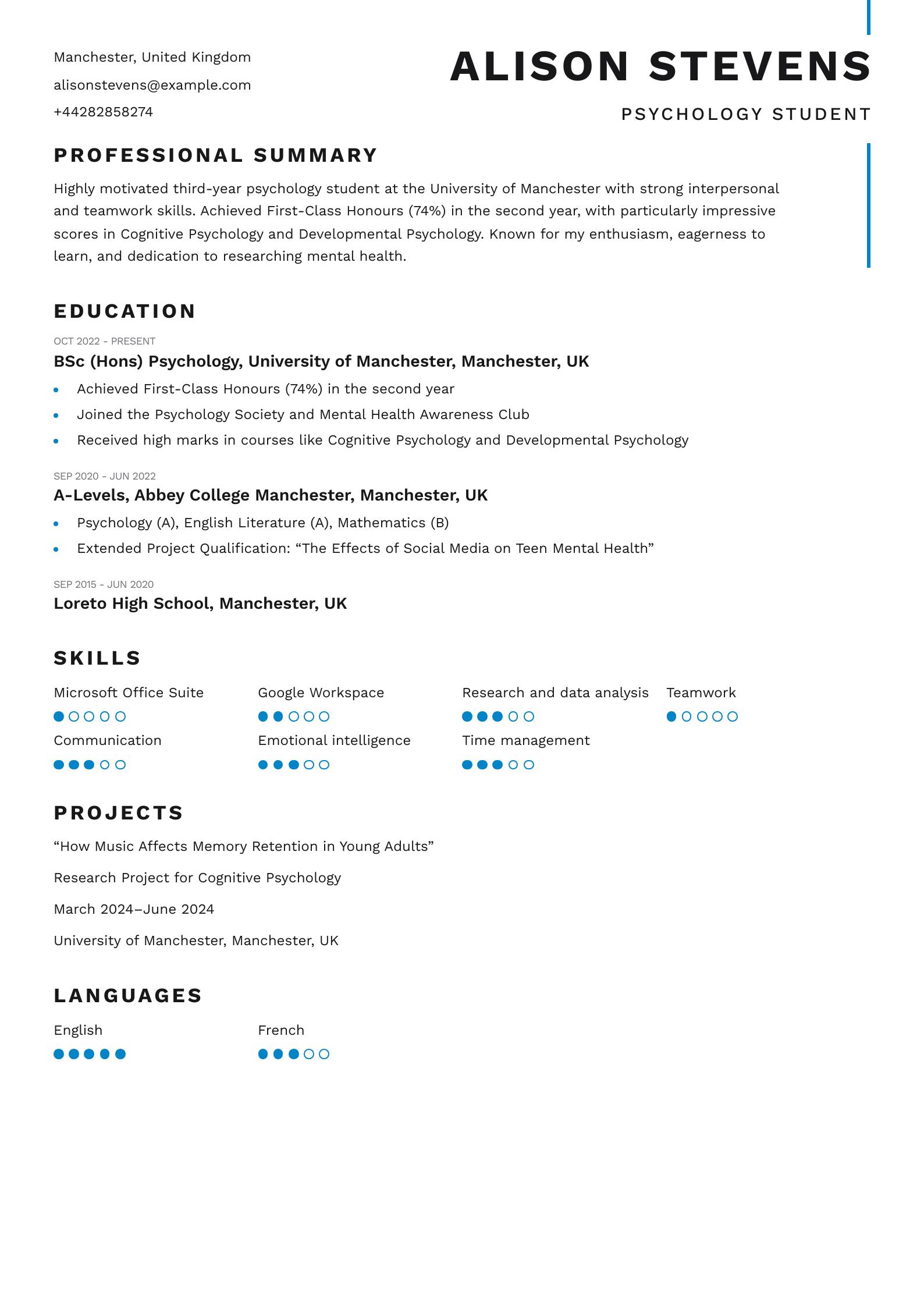
Student CV examples can help you understand how to write an effective job application, even when you lack the experience that older candidates typically have. As a result, you’ll be able to secure your first role and take a step on the career path of your dreams.
In this article, we will teach you how to write a student CV for the UK market, what formatting rules you should pay attention to, and what mistakes you should avoid. Furthermore, we will provide excellent student CV examples to inspire your writing process.
Key Takeaways
A student CV is used by individuals who are still completing their education and may, therefore, lack the work experience and skills of older candidates.
In the UK, CVs for students are formatted like all others; they should follow reverse chronological order, use professional fonts, and combine paragraphs and bullet points with white space.
A student CV examples typically focus on the education, skills, and projects sections, while work experience can be omitted if there is none.
Every good example of a first job CV is concise, carefully proofread, tailored to a specific job description, and focused on transferable skills.
2 Professional Student CV Examples
Let’s start with the most important part: student CV examples for the UK job market. Below, you will find two documents; the first is a student CV for a candidate with no work experience, while the second includes some professional background.
Student CV Format and Structure
The correct CV format for students in the UK features:
Student CV Formatting Guidelines
Reverse chronological order. All information in your education and work experience sections should be listed chronologically, starting with the most recent one. That way, hiring managers can easily follow the trajectory of your professional and academic life and immediately take note of the most important information.
Professional CV font. Arial, Calibri, Times New Roman, and Helvetica are among the most commonly used fonts for CVs, as they are readable, clean, and visually appealing. Steer clear of illegible or overly artsy fonts; they will make your application look childish and unserious.
Paragraphs and bullet points. Your CV should be visually appealing at first glance, cleverly combining text and white space. Avoid long paragraphs that clutter the space; instead, use short sentences and bullet points when explanations are necessary.
How to Write a Student CV for Your First Job
Writing a student CV for your first job can be difficult when you lack the job experience that usually makes up the bulk of a standard application document. However, it’s not impossible; you simply need to focus on other aspects, such as your education or relevant skills.
Now, let’s examine how to write a student CV in more detail:
#1. Add Your Contact Information
First and foremost, don’t forget your contact information, which is a crucial part of every CV header. Although it doesn’t say anything about your skills and experience, it does give your potential employer a way to contact you before the next hiring step.
The contact information section should contain your full name, address, email address, phone number, and, optionally, LinkedIn profile and professional website. Make sure to double-check that all the details are correct, and don’t include anything irrelevant. For instance, there’s no room on your CV for personal Instagram pages and blogs.
You should structure your contact information section like this:
Contact Information Section Example
Alison Stevens
Manchester, United Kingdom
+44282858274
#2. Write a Strong Personal Statement
A personal statement is placed directly below the contact information, providing a snapshot of your most significant achievements and skills. It’s usually only 2–3 sentences long, so each word should count and contribute to the professional image you want to create.
The most effective way to use this section is to briefly introduce yourself and your background, then pick one achievement to highlight, incorporating action words and quantifiable results. However, this can be somewhat challenging for students who haven’t yet entered the job market.
In that case, we recommend following a similar approach, but focusing on your academic achievements instead. Choose a project you participated in or an extracurricular activity you’re especially proud of and emphasise that. Then, conclude the paragraph by highlighting your traits and soft skills that are relevant to the job.
One effective example of a good personal statement can look like the following:
Personal Statement Section Example
Personal Statement
Highly motivated third-year psychology student at the University of Manchester with strong interpersonal and teamwork skills. Achieved First-Class Honours (74%) in the second year, with particularly impressive scores in Cognitive Psychology and Developmental Psychology. Known for my enthusiasm, eagerness to learn, and dedication to researching mental health.
#3. Highlight Your Education Section
Considering that most students lack significant work experience, the education section becomes the most important part of their CV. It’s best to place it right underneath the personal statement, starting with your latest degree and working backwards to your GCSEs.
Although other types of CVs typically only mention the degree type, institution, and study period, student applications can provide more detailed information. For example, you can list your accomplishments and relevant courses in bullet points, or even mention your average if it is particularly high.
When providing this extra information, try to be as specific as possible and use action verbs. Instead of being “chosen” or “awarded,” say that you “obtained,” “achieved,” “joined”, or “created.” That way, you’ll sound more proactive, responsible, and capable.
This is a great way to organise this section:
Education Section Example
Education
BSc (Hons) Psychology
October 2022–Present
University of Manchester, Manchester, UK
Achieved First-Class Honours (74%) in the second year
Joined the Psychology Society and Mental Health Awareness Club
Received high marks in courses like Cognitive Psychology and Developmental Psychology
A-Levels
September 2020–June 2022
Abbey College Manchester, Manchester, UK
Psychology (A), English Literature (A), Mathematics (B)
Extended Project Qualification: “The Effects of Social Media on Teen Mental Health”
Loreto High School
September 2015–June 2020
Manchester, UK
#4. Include Extracurricular Activities
Extracurricular activities can also serve as a replacement for the work experience section and highlight many of the skills you possess. Essentially, they encompass anything you do outside your school work: clubs, volunteering, personal projects, sports, and associations.
These activities can be added to your CV as a separate section or incorporated into other sections. For instance, sports can be included in hobbies and interests, while volunteering often falls under work experience.
Here’s one way to add extracurricular activities to your application:
Volunteering Section Example
Volunteering
Art Assistant
September 2023
Brighton Arts Festival
Assisted with designing and placing promotional posters across the city
Interacted with and guided visitors during the first weekend
Helped set up artists’ stalls and booths
#5. Add Relevant Skills
As you have seen from our student CV examples, the skills section is also crucial and often placed right underneath education. Along with an academic background and extracurricular activities, it can compensate for your lack of professional experience.
So, try to think of as many skills as you can and list them in bullet points, starting from hard skills and moving on to soft ones.
As a student, you likely won’t have as many technical skills as more experienced professionals, but don’t worry about it. Focus on your strengths, take advantage of your transferable skills (your research abilities, digital literacy, or written communication), and prepare to show you’re eager to learn during an interview.
Here’s what the skills section might look like:
Skills Section Example
Skills
Microsoft Office Suite
Google Workspace
Research and data analysis
Teamwork
Communication
Emotional intelligence
Time management
#6. Work Experience
As important as this section is, you’ll likely have to omit it entirely if you’re writing a student CV with no experience. Of course, you can fill it with volunteering experiences, part-time jobs, and projects, but if nothing comes to mind, it’s best to leave it out and focus on other sections.
However, if you do have work experience to include, place it below your education and list your job positions in reverse chronological order. Make sure to emphasise whether you were working part-time, freelancing, or volunteering, and follow the standard formula of adding your achievements as bullet points.
Here’s what a work experience section can look like on a student CV example:
Work Experience Section Example
Work Experience
Freelance Designer
July 2023–Present
Collaborated with 10+ clients from all across the globe
Successfully completed 20+ projects, some of which required teamwork with other designers
Learned to juggle several tasks at the same time and meet deadlines

Student CV Example Template
If you need extra help writing your application, here is a CV template for students you can simply fill out with your information to make it your own:
Student CV Example Template
[Full name]
[Address]
[Email]
[Phone number]
[LinkedIn profile or website] (optional)
Personal Statement
Dedicated/Motivated/Creative student of [X] year at [University name] with a passion for/background in [Subject of interest]. [Summarise briefly your greatest professional accomplishment using action words and measurable outcomes when possible.] Known for [Specific traits and transferable skills relevant to the position.]
Education
[Latest degree type and title]
[Start date] – [End date]
[School name], [City], [Country]
Achievement #1 (you can also mention the most important courses you attended)
Achievement #2
Achievement #3
[Previous degree type and title]
[Start date] – [End date]
[School name], [City], [Country]
Work Experience
[Your title]
[Company name], [City], [Country]
[Start date] – [End date]
Responsibility/Achievement #1
Responsibility/Achievement #2
Responsibility/Achievement #3
Skills
Hard skill #1
Hard skill #2
Hard skill #3
Soft skill #1
Soft skill #2
Soft skill #3
Projects
Project Name
[Start date] – [End date]
[Organisation], [City], [Country]
(optional) Further clarification about the project
Languages
Language #1 – [Fluency level]
Language #2 – [Fluency level]
Language #3 – [Fluency level]
5 Important Tips for Creating a Student CV
The most important tips for creating a student CV include focusing on transferable skills, tailoring your CV to each job application, limiting the application’s length to one page, proofreading your document, and avoiding exaggeration.
Let’s examine them more closely.
#1. Focus on Transferable Skills
Transferable skills are your trump card; you may not possess the hard skills that are picked up through experience and practice, but you undoubtedly have other useful abilities. For example, soft skills like communication, problem-solving, or leadership can be included regardless of the position you’re applying for.
Furthermore, some hard skills are transferable, too, and you likely possess them if you spend much time on your computer. Digital literacy and the use of common software, such as the Microsoft Office Suite, fall under this category. You can always list these as your skills and pad out your application a little.
#2. Tailor Your CV to Each Job Application
You should never use a one-size-fits-all approach for your CVs; this may make them appear generic and lower your chances of getting noticed. Instead, tailor them for each of your applications, paying special attention to keywords and requirements mentioned in the job description.
Of course, that doesn’t mean you have to write a brand new CV every time you apply for a job; you can use one as a basis and then tweak it for each new position.
#3. Be Concise and Keep It One Page
Normally, CVs are 1–2 pages long, but we suggest sticking to one page, especially because you likely don’t have much experience as a student. In other words, there’s no need to add information just to make the document longer. Write about relevant skills and experiences, no more and no less.
Also, remember that long paragraphs of text generally aren’t welcome on a CV. The longest one will be your personal statement; everything else should be briefly elaborated on in bullet points. Save lengthier explanations for the cover letter or, better yet, the interview.
#4. Proofread Your Document
There should be no grammar mistakes or typos in your CV, especially not the glaring ones. Most recruiters consider this highly unprofessional and are likely to reject applications that aren’t properly proofread.
So, double-check your CV after you’ve finished writing and run it through a grammar checker before submission. You can also ask someone to look over it for you; another pair of eyes can spot the mistakes you might have missed.
#5. Don’t Exaggerate
One of the best CV tips for students we can give is to avoid exaggeration and lying on an application document. It may be tempting to add skills you don’t possess or exaggerate your average marks, but it’s not wise. You may be hired, but you won’t last long if your abilities don’t match up with your claims.
Build a Compelling Student CV With CV.co
If you want to create a job-winning student application, use our CV builder and enter the required information to generate one in less than 15 minutes. Then, pick the design and template to complete your document and submit it to the employer right away.
And if you don’t want to rely on our AI assistant, browse through our CV examples. We have an extensive catalogue for different professions and career levels, so you’ll surely find one for your industry to inspire you.
Final Thoughts
Thanks to our writing tips and examples of entry-level CVs, you should be able to make a compelling student application document in no time. Focus on your skills and academic background, and don’t worry about the work experience you lack. After all, everyone has to start somewhere.
If you need extra help with writing, use one of our CV templates and simply enter your information in the empty slots. We have dozens of options for various industries, so you’ll surely find what you need.
Student CV Example FAQ
#1. What do I put on my CV if I don’t have any experience as a student?
If you don’t have any experience as a student, you should put your skills, academic achievements, and extracurricular projects on your CV. Your education is your biggest asset, so be sure to place it right underneath the personal statement and elaborate on courses you’ve attended, papers you’ve written, and research you’ve done.
#2. What are good skills to put on a student CV?
Good skills to put on a student CV are soft and transferable skills, as well as any hard skills you may have picked up in classes. Don’t worry if you lack technical abilities; those are often learned through experience. Just highlight your strengths, particularly communication, teamwork, leadership, and problem-solving.
#3. What’s the difference between a student, graduate, and internship CV?
The difference between a student, graduate, and internship CV is in who uses each type and for what purpose. Graduate CVs and student documents have very distinct user groups: the individuals with university degrees for the former and those who are still studying for the latter. On the other hand, internship CVs are used by both when they apply for internships.